
Metro Construction in India: The Second Wave of Cities

Metro construction in India did not stop with the big cities
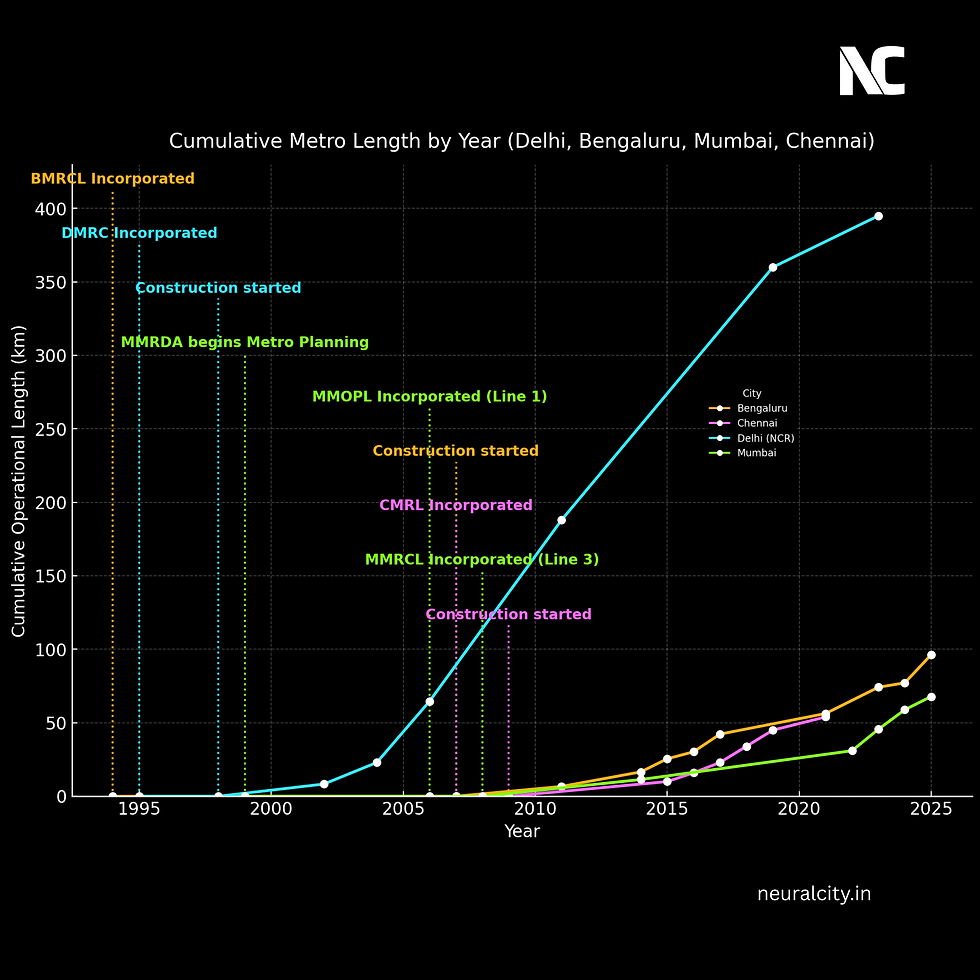
In our earlier analysis (Metro Construction: A Data View of Indian Cities) we looked at how India’s largest metros built their networks over time. Cities like Delhi, Bengaluru, Mumbai and Chennai showed what early political backing, institutional capacity, and sustained funding can achieve over decades.
But India’s metro story does not end there.
Over the last ten to fifteen years, a second wave of cities has entered the metro era. These are not megacities. They are mid-sized, fast-growing urban centres where metros were planned later, built under tighter constraints, and often executed under greater pressure to deliver quickly.
This follow-up analysis focuses on that second wave.
Using the same data-driven approach as before, we examine how metros have evolved in Jaipur, Nagpur, Kochi, Lucknow, Kanpur, and Indore. We track when planning began, how long it took to move from approvals to construction, when passenger operations actually started, and how operational network length has grown year by year.
What emerges is a different pattern of metro development.
These cities did not have the luxury of long gestation periods.
Many compressed planning and execution into shorter timeframes.
Some delivered rapid expansions soon after launch, while others are still in early operational phases.

By placing these cities on the same timeline and measuring only what is operational, this analysis helps answer a simple but important question.
How quickly can Indian cities move from intent to infrastructure when they start late, but cannot afford to fail?This is not just a transport story. It is a story about institutional learning, execution capacity, and how India’s urban governance has evolved beyond its largest metros.
Kanpur
Notes for analysis: Fastest phase-I opening in India by time from start to first passenger service.
Year | Description | Metro length (km) | Source |
2015 | Feasibility study for Kanpur Metro conducted by RITES | 0 | RITES feasibility study, UP Govt transport dept |
2016 | DPR for Kanpur Metro Phase 1 (two corridors) approved by Uttar Pradesh government | 0 | Uttar Pradesh Cabinet approval, MoHUA records |
2019 | Union Cabinet approval for Kanpur Metro Rail Project | 0 | Cabinet Committee on Economic Affairs, Govt of India |
2021 | Phase 1 priority corridor opened for passenger services (IIT Kanpur to Motijheel) | ~9 | UPMRC press release, PMO inauguration note |
2025 | Underground stretch opened up to Kanpur Central Railway Station (5 new underground stations) | ~7 | UPMRC operations update, Ministry of Housing and Urban Affairs |
Jan 2026 | Total operational Kanpur Metro network (IIT Kanpur to Kanpur Central) | ~16 | UPMRC official website and annual status reports |
Jaipur
Notes for analysis: One of the earlier Tier-II city metros in India; limited length compared with larger urban systems.
Year | Description | Metro length (km) | Source |
2009 | Project approved / planning initiated for Jaipur Metro Rail Project | 0 | Project approval info (Jaipur Metro origins) (JaipurMetroRoutes) |
1 Jan 2010 | Jaipur Metro Rail Corporation (JMRC) created to plan, build, operate metro | 0 | JMRC creation details (Wikipedia) |
Mar 2010 | Initial DPR for Jaipur Metro submitted by DMRC (two corridors) | 0 | DPR initial submission info (Metro Rail News) |
Apr 2011 | DPR revised; decision to bifurcate into phases | 0 | DPR revisions noted (Metro Rail News) |
13 Nov 2010 | Construction on Phase 1A started (Mansarovar–Chandpole) | 0 | Construction start detail (Testbook) |
3 Jun 2015 | Phase 1A opened (Mansarovar to Chandpole) | ~9.6 | Phase 1A opening info (Wikipedia) |
23 Sep 2020 | Phase 1B opened (Chandpole to Badi Chaupar) completing Pink Line | ~2.3 | Phase 1B opening detail (Wikipedia) |
Dec 11 2025 | DPR for Phase 2 approved by Public Investment Board (PIB) (next phase planning) | 0 | DPR Phase 2 approval (Indian Infrastructure) |
Jan 2026 | Total operational Jaipur Metro network (Pink Line: Mansarovar–Badi Chaupar) | ~11.97 | System length from Wiki (Wikipedia) |
Lucknow
Notes for analysis: Phase-1 extensions approved and underway, expanding connectivity significantly.
Year | Description | Metro length (km) | Source |
2012 | DMRC submitted the final DPR for Lucknow Metro (2 corridors) | 0 | DMRC document noting DPR submission in Aug 2012 (Delhi Metro Rail Corporation) |
Jun 2013 | UP State Cabinet cleared the Lucknow Metro network (project go-ahead at state level) | 0 | Lucknow Metro Rail Corporation brief timeline (state cabinet clearance) (bbamantra.com) |
Aug 2013 | UP Government approved DPR submitted by DMRC | 0 | Same LMRC brief timeline (DPR approval) (bbamantra.com) |
Oct 2013 | Final DPR (Revised Oct 2013) published (project baseline document) | 0 | “Lucknow_DPR_Oct2013_Final.pdf” (upmrcl-media.s3.ap-south-1.amazonaws.com) |
25 Nov 2013 | LMRC incorporated (SPV created to implement/operate metro; later became UPMRC) | 0 | UPMRC official site (incorporation date) (upmetrorail.com) |
27 Sep 2014 | Construction began for Phase 1A (priority corridor civil work start) | 0 | Wikipedia project timeline (construction begin date) (Wikipedia) |
06 Aug 2015 | Public Investment Board (PIB) clearance for Lucknow Metro (Phase 1A) | 0 | Wikipedia timeline lists PIB clearance date (Wikipedia) |
22 Dec 2015 | Union Cabinet approval for Lucknow Metro Phase 1A: 22.878 km, 22 stations | 0 | PIB Press Release (Cabinet approval) (Press Information Bureau) |
05 Sep 2017 | Phase 1A opened (Priority Corridor): Transport Nagar to Charbagh, 8.5 km | 8.5 | UPMRC/UPMRCL official site notes 8.5 km revenue ops date (upmetrorail.com) |
08 Mar 2019 | Full North–South corridor opened (extensions to Airport and Munshipulia); operational corridor becomes 22.878 km | 22.878 | UPMRC/UPMRCL project overview and operations summary (lucknow.upmetrorail.com) |
Jan 2026 | Total operational length (as of Jan 2026) remains the North–South corridor CCS Airport to Munshipulia: 22.878 km | 22.878 | UPMRC/UPMRCL project overview page (operational corridor length) (lucknow.upmetrorail.com) |
Phase naming is commonly presented as Phase 1A (North–South Corridor) with the 2017 “priority corridor” first, and the full corridor opening in 2019 as extensions.
Lucknow’s next big expansion (East–West / Phase 1B) got Union Cabinet approval in 2024, but it is not operational by Jan 2026
Indore
Notes for analysis: One of the shortest operating networks in India currently, with extensions expected soon.
Year | Description | Metro length (km) | Source |
2010 | Early planning signal: DMRC surveyed Indore for metro rail (project exploration stage) | 0 | Indore Metro background references DMRC survey (Apr 2010) (Wikipedia) |
09 Jul 2015 | MP Metro Rail Company (MPMRCL) incorporated (implementing agency/SPV for MP metros, including Indore) | 0 | Economic Times company profile (MCA-based listing) (The Economic Times) |
Oct 2018 | Union Cabinet approved Indore Metro Rail Project (Ring Line concept, 31.55 km, 30 stations) | 0 | Press Information Bureau release dated 03 Oct 2018 (Press Information Bureau) |
Oct 2018 | Central approvals package for MP metros (Bhopal + Indore) noted as “central government approved” (project moves to execution readiness) | 0 | Indian Infrastructure sector note (Oct 2018 approval mention) (Indian Infrastructure) |
2019 | Construction started (civil work begins; project execution phase) | 0 | Railway-Technology project overview notes construction began in 2019 (railway-technology.com) |
31 May 2025 | Passenger operations inaugurated on “Super Priority Corridor” (first operational section) | 0 (opening event) | TOI coverage of launch day and corridor description (The Times of India) |
01 Jun 2025 | Commercial services commenced on the first operational 6 km stretch | 6 | Railway Pro report on opening and 6 km start of service (railwaypro.com) |
2025 (Sep–Oct) | Trial runs extended beyond initial 6 km; target announced to extend commercial ops toward Radisson Square by Jan 2026 | 6 (still operational) | Times of India trial-run reporting (commercial ops “aim”) (The Times of India) |
15–25 Jan 2026 | Services suspended on the currently operational stretch (Gandhi Nagar to Super Corridor-03) for testing/commissioning to integrate with the longer corridor | 6 (still operational network) | Times of India (Jan 2026 mega block; confirms currently operational stretch and commissioning stage) (The Times of India) |
Jan 2026 | Total operational length (as of Jan 2026): 6 km (Gandhi Nagar to Super Corridor-03); longer priority corridor is in testing/commissioning | 6 | Times of India (current operational stretch and integration work) (The Times of India) |
Multiple sources talk about planned/targeted extension to ~17.5 km by “January 2026 / early 2026”. Those are targets, not confirmed public operations. The most current Jan 2026 reporting explicitly shows the operational section is still the initial corridor and the rest is in commissioning/testing.
Kochi
Notes for analysis: First metro to integrate with a water metro system experimentally (though that is separate from the rail network itself).
Single main corridor with phased incremental extensions
Strong multimodal integration narrative (Water Metro, buses) but rail km counted separately
Steady expansion rather than large single jumps
Year | Description | Metro length (km) | Source |
2010 | Planning initiated for Kochi Metro as part of Kerala urban mobility strategy | 0 | Govt of Kerala transport planning records |
2011 | DPR prepared and submitted by DMRC for Kochi Metro | 0 | DMRC DPR submission archive |
2012 | Union Cabinet approval for Kochi Metro Phase 1 | 0 | PIB Press Release, Govt of India |
Aug 2013 | Kochi Metro Rail Ltd (KMRL) incorporated as SPV | 0 | KMRL official website |
Jun 2013 | Construction work commenced on Phase 1 | 0 | KMRL construction timeline |
Jun 2017 | First phase opened (Aluva to Palarivattom) | ~13 | KMRL operations announcement |
Oct 2017 | Extension opened up to Maharaja’s College | ~18 | KMRL phase extension notice |
Sep 2019 | Final Phase 1 extension opened (to Tripunithura initially planned, later phased) | ~25 | KMRL operational update |
2023 | Extension to SN Junction commissioned | ~27 | KMRL extension announcement |
Jan 2026 | Total operational Kochi Metro network | ~27 | KMRL annual report |
Nagpur
Notes for analysis: Completed Phase-I by late 2022 with steady growth in passengers.
Two corridors fully operational
One of the fastest completions among Tier-2 Indian metros
Entire Phase 1 delivered within about 7 years from approval
Year | Description | Metro length (km) | Source |
2011 | Initial metro rail concept and feasibility discussions initiated for Nagpur | 0 | Maharashtra Govt urban transport notes, MahaMetro background |
2012 | DPR prepared for Nagpur Metro by DMRC | 0 | DMRC project documentation |
2013 | Union Cabinet approval for Nagpur Metro Phase 1 (two corridors) | 0 | PIB Press Release, Govt of India |
2015 | Nagpur Metro Rail Corporation Ltd (MahaMetro) incorporated as SPV | 0 | MahaMetro official website |
2015 | Construction work formally commenced on both corridors | 0 | MahaMetro construction timeline |
Mar 2019 | Phase 1A opened (Sitabuldi Interchange to Khapri and Sitabuldi to Lokmanya Nagar) | ~13 | MahaMetro operations update |
Jan 2020 | Extended elevated sections opened on both Orange and Aqua lines | ~20 | MahaMetro phase opening notices |
Dec 2022 | Full Phase 1 completed (Orange Line + Aqua Line operational end to end) | ~38 | MahaMetro completion announcement |
Jan 2026 | Total operational Nagpur Metro network (Phase 1 complete) | ~38 | MahaMetro annual status report |


Comments